
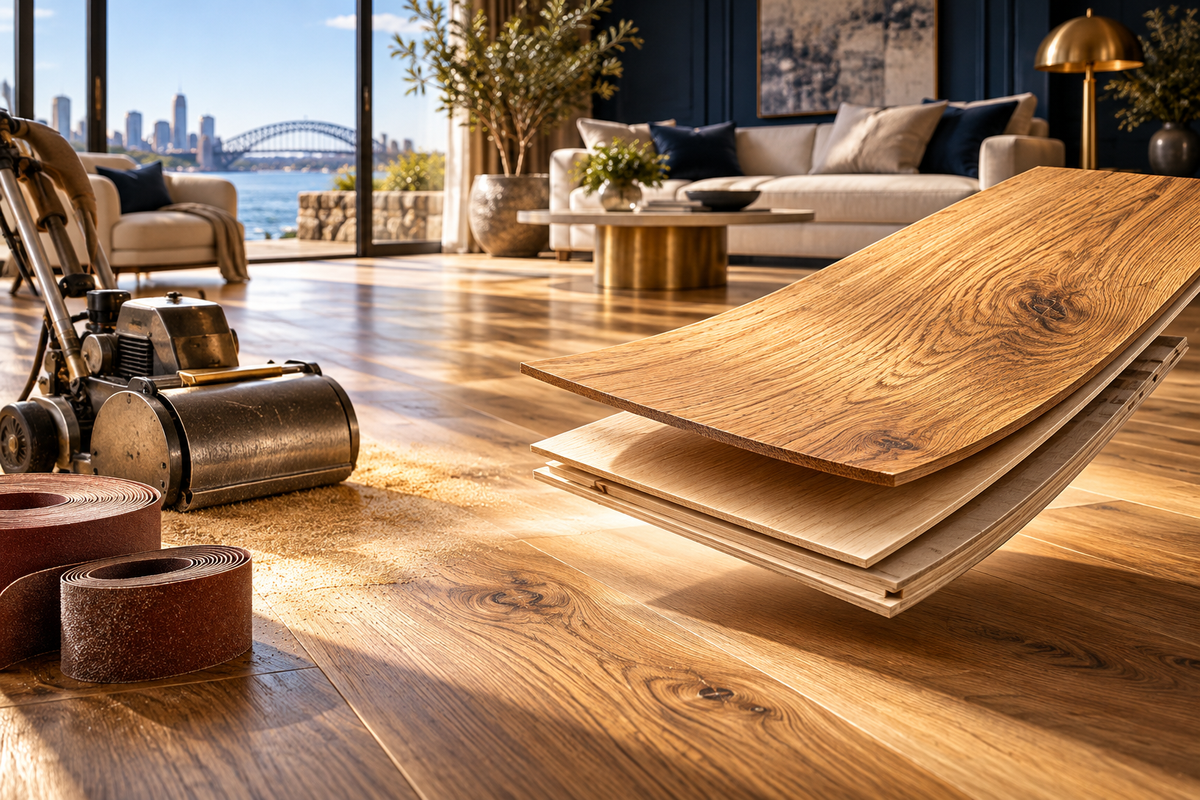
Can engineered floors be sanded? Some can, provided enough usable timber remains above the core and the boards are sound, stable and approved for refinishing. Others have a thin veneer that should not be sanded. Check the actual remaining wear layer, previous sanding and manufacturer instructions before choosing a full sand, a compatible recoat or board replacement. Total board thickness alone does not answer the question.
| Floor condition | Appropriate next step | Main limitation |
|---|---|---|
| Dirt or cleaner residue on an intact finish | Use the finish manufacturer’s approved cleaning method | Cleaning cannot remove damage within the timber |
| Light wear confined to a sound coating | Assess compatibility for a maintenance recoat | Contamination or poor adhesion can rule it out |
| Timber damage with sufficient usable wear layer | Assess a controlled sand and refinish | Damage depth, texture and previous sanding affect suitability |
| Thin, unknown or already depleted veneer | Confirm construction before any abrasive work | Sanding through the surface cannot be reversed |
| Loose, swollen or delaminating boards | Resolve the cause and assess repair or replacement | A fresh finish cannot correct an unstable floor |
Can Engineered Floors Be Sanded? What Decides the Answer
The word engineered describes how the board is built, not how much sanding it can take. Two floors that look alike from above may have very different restoration options.
The timber surface is the working allowance
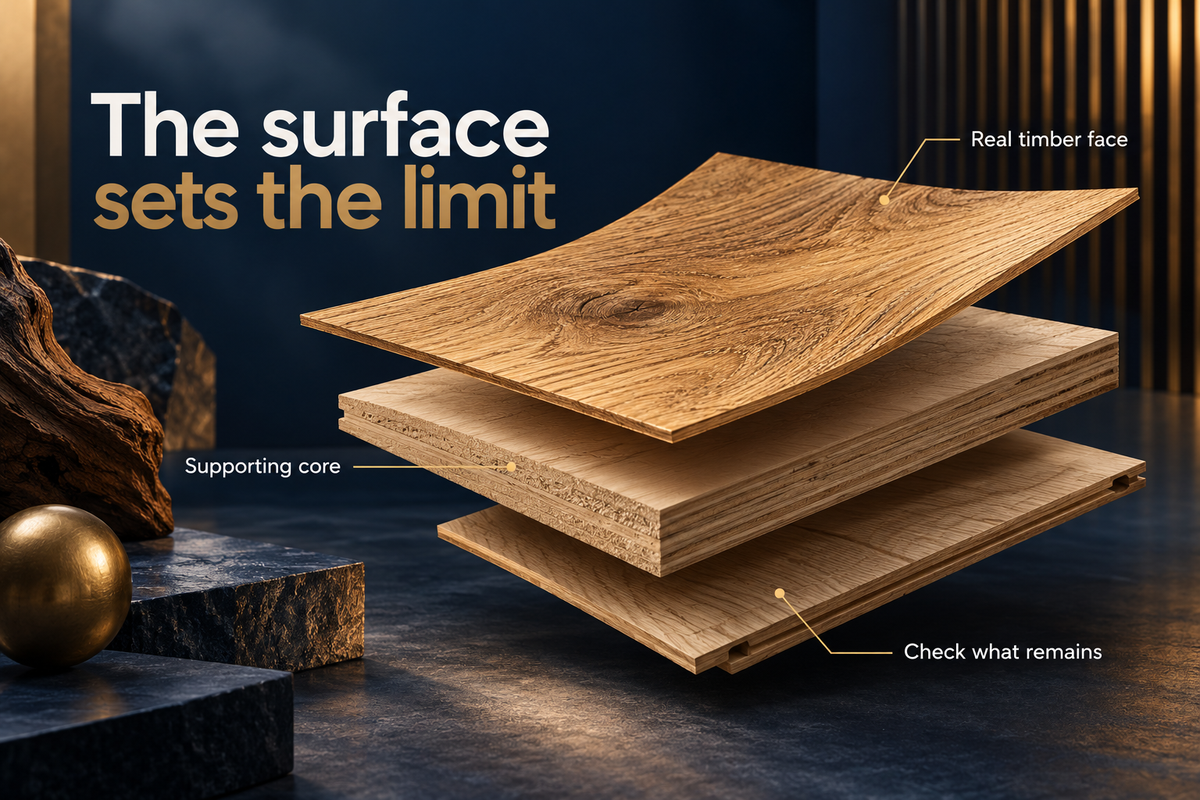
An engineered board has a real timber face bonded to supporting layers. Sanding removes material from that face; it does not create more usable timber. Once the sanding reaches the core, the appearance and integrity of the surface have been compromised. A thick overall board can still have a relatively thin decorative face.
Product guidance comes before rules of thumb
As a reference point, the NWFA’s engineered flooring certification criteria specify a minimum 2.5 mm wear layer for factory-finished products entering that programme. This is a product certification threshold, not permission to sand every installed floor measuring 2.5 mm. Existing wear, previous work and the amount of correction required still matter.
The installed floor must be suitable
A board may be resandable in its original specification but unsuitable today. Loose sections, deep gouges, uneven edges or a damaged bond can change the recommendation. The assessment must cover the floor in front of you, rather than the best-case condition shown in a brochure.
How to Check the Remaining Wear Layer
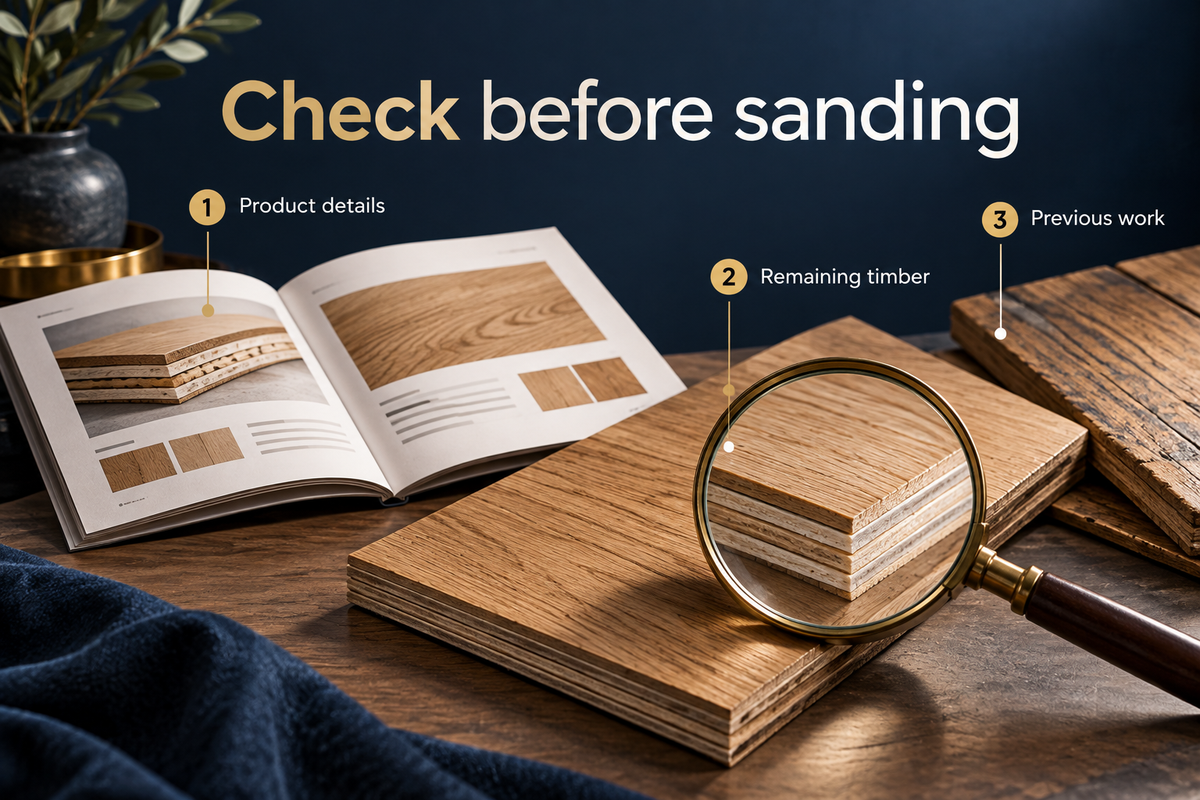
Start with records and accessible board edges, rather than making a test gouge in the floor. The aim is to identify the product and establish what remains without creating extra damage.
- Find the manufacturer, product name and original installation documents. Ask for the refinishing instructions for that exact range, including restrictions on textured or stained surfaces.
- Keep an unused board if one is available. It shows the original construction, although it cannot establish how much timber has already been removed from the installed floor.
- Ask the assessor to inspect a suitable exposed edge, where accessible without damage. A doorway or existing service opening may offer useful evidence; do not prise up boards simply to look.
- Explain any known sanding history. A previous owner’s account is useful context, but it is not a substitute for inspecting remaining material.
- Identify the deepest damage and highest board edges. The amount needed to correct those areas can be more important than the average condition.
- Include transitions, bevels and textured areas in the inspection. One convenient edge may not represent the thinnest point elsewhere.
- Keep uncertain measurements labelled as uncertain. A restoration plan should not turn an estimate into a guaranteed number of future sanding cycles.
Cleaning, Recoating or Full Sanding?
Restoration is not a choice between ignoring the floor and stripping it completely. The useful distinction is whether the problem sits on the coating, within it or below it.
Cleaning an intact surface
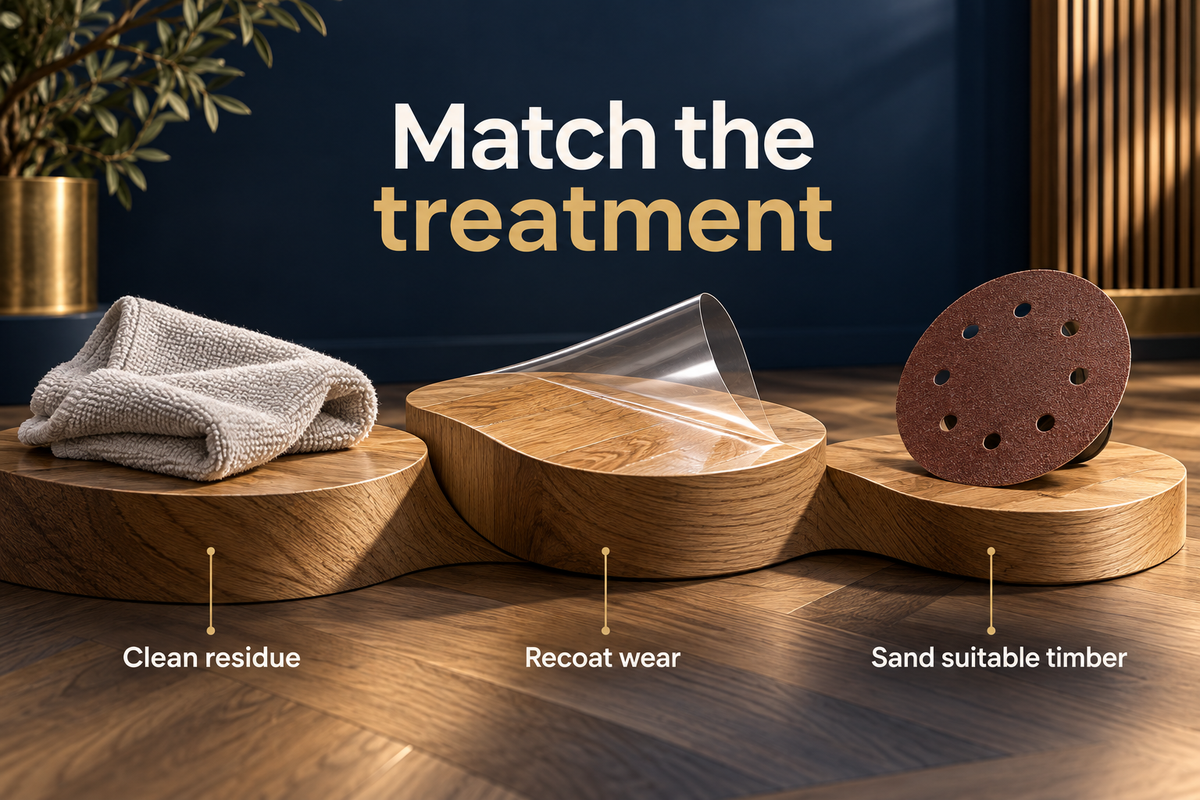
If the floor looks dull because of residue, approved cleaning may improve its appearance without removing timber. Check what has previously been applied: polish, wax, oil soap or other maintenance products can affect the next treatment. Repeatedly adding a gloss product can hide the problem briefly while making later coating work harder to assess.
Recoating a compatible finish
A maintenance recoat renews a suitable existing finish after the prescribed preparation. It will not reliably remove deep timber scratches or reverse a colour change within the wood. Bona’s explanation of recoating distinguishes this approach from a full renovation, particularly where preserving a limited surface layer matters. Compatibility and adhesion testing remain essential.
Sanding back to timber
Full sanding removes the existing finish and some timber before a new finish is applied. It can address suitable surface damage or enable a different colour treatment, but only within the floor’s remaining allowance. Discuss whether a deeper mark should be accepted or a board replaced instead of removing excessive material across the room.
| Treatment | Removes the old coating completely? | Changes damage within the timber? |
|---|---|---|
| Approved cleaning | No | No |
| Compatible maintenance recoat | Usually no | No, although the overall sheen may improve |
| Full sand and refinish | Yes | May reduce damage within the available sanding allowance |
| Local board replacement | Replaces the affected board | Removes damage contained in that board, with matching limitations |
Conditions That Rule Out Sanding
A cautious refusal can protect a floor that still has useful life. Some conditions require another treatment, while others need investigation before any decision is made.
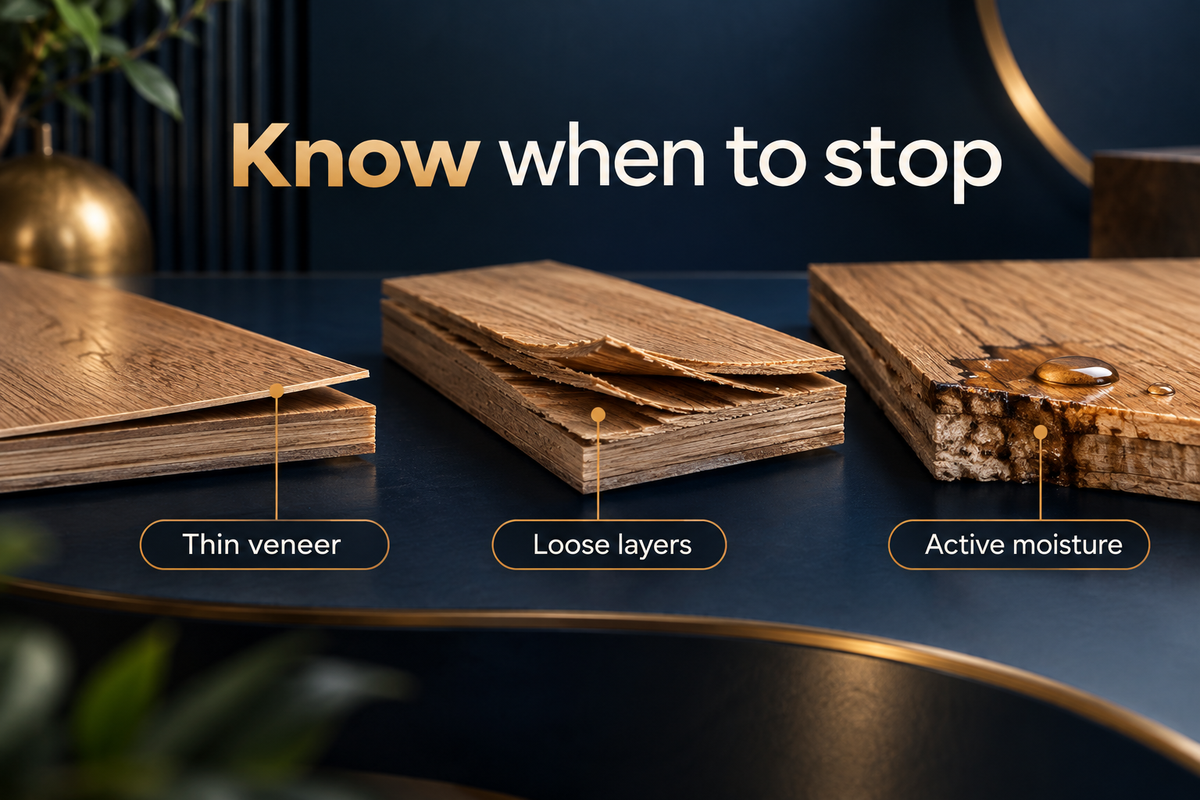
- A product identified by its manufacturer as non-resandable should not be treated like a thicker engineered range.
- A depleted or uncertain veneer needs further assessment; an aggressive trial pass is not a safe way to find the core.
- Delamination, splitting or softness may mean the board itself has failed. A coating cannot repair the bond between layers.
- Active leaks, abnormal moisture or continuing movement must be addressed before cosmetic work is planned.
- Deep staining or gouges may extend beyond a safe sanding depth, even when the surrounding boards are suitable.
- Excessive movement underfoot can interfere with an even result and may indicate an installation or subfloor problem.
- Existing product warranties or maintenance restrictions should be checked before changing the finish system.
Where the issue involves damaged boards rather than ordinary surface wear, timber floor repair in Sydney should be considered before the refinishing scope is settled.
What Happens to Colour, Texture and Bevels?
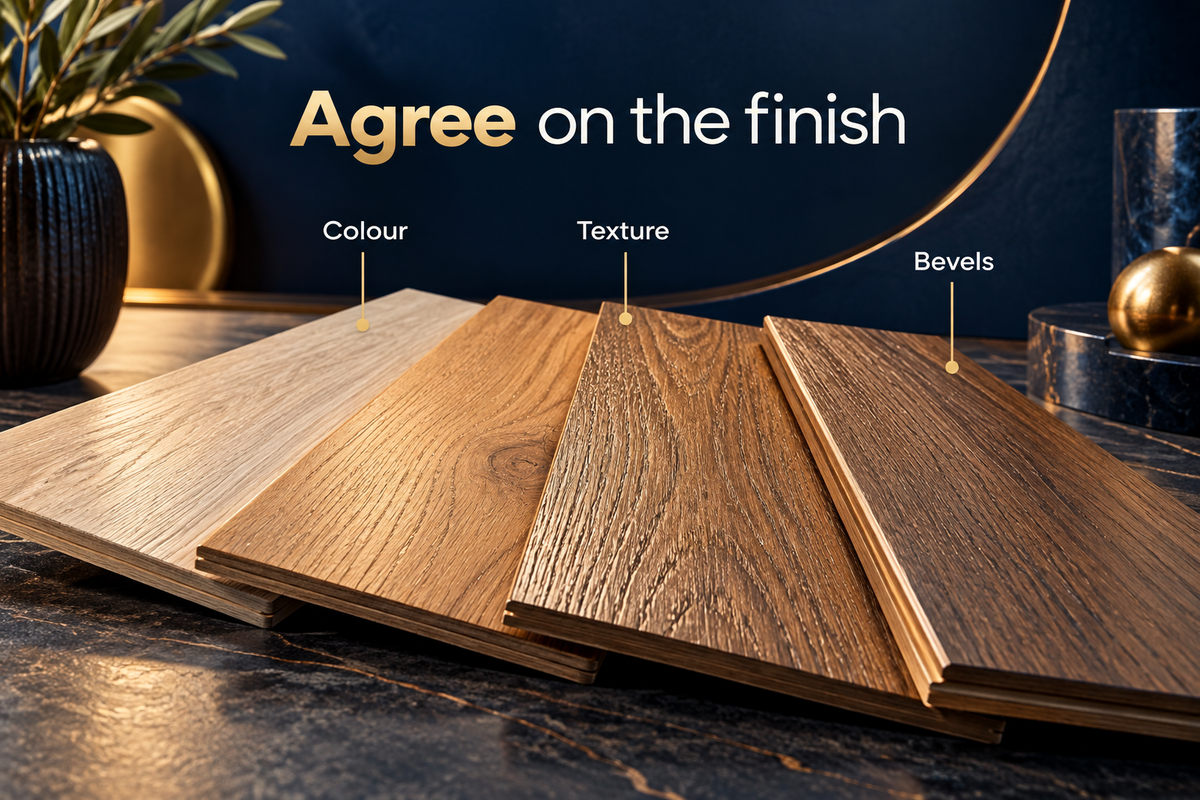
A sanded engineered floor may look different even when no new stain is added. Removing an aged coating can expose timber that is lighter, less amber or simply different from the surface you have lived with. Natural variation between boards remains, and sunlight may have affected some areas more than others.
Wire brushing, hand scraping and bevels complicate the decision. Flattening the high points can reduce or remove the original texture, while colour may remain in lower areas. Trying to erase every dark recess may use too much timber. Ask which original details can realistically be retained before approving a smooth, uniform look.
A sample helps establish the likely colour and sheen, but repeated samples on the installed floor also consume material. Agree on a suitable sample location and examine it in the room’s actual light. Treat a colour sample as an appearance guide, not proof that every board will finish identically.
How a Professional Restoration Is Planned
A useful plan explains both the intended result and the point at which work should stop. That discussion is especially important where the timber allowance is limited.
Assessment and repair decisions
The floor’s construction, condition and product guidance are checked first. Any loose or damaged boards are considered alongside moisture findings. If replacement is necessary, available matching boards and the effect on adjoining flooring should be discussed before surface preparation begins.
Preparation and a controlled method
Rooms need suitable access, protection and dust management. The contractor selects equipment and abrasives for the coating and timber condition rather than applying one universal sequence. Sanding should remove what is necessary for the agreed finish, not chase every imperfection regardless of the remaining face layer.
Coating and handover
The selected coating must suit the prepared surface and the intended use of the room. Recoat intervals, ventilation, furniture return and cleaning instructions come from that coating system and the conditions on site. A floor that feels dry is not automatically ready for rugs or heavy furniture. Keep the product details for future maintenance.
The purpose of professional timber floor sanding is to match the process to the floor, including recognising when a lighter treatment is the better option.
Looking After the Refinished Surface
Good care protects the finish and helps preserve the limited timber beneath it. Follow the written handover instructions before returning to ordinary cleaning.
- Use the recommended cleaner and application method, rather than assuming every timber product suits every finish.
- Lift furniture instead of dragging it and maintain suitable protective pads beneath contact points.
- Remove grit with a clean, soft cleaning head that cannot scratch the coating.
- Deal with spills promptly and inspect around plant pots, entrance mats and appliances.
- Keep indoor conditions within the flooring manufacturer’s recommendations and avoid concentrated heat on one area.
- Ask about maintenance recoating while wear is still in the finish, rather than waiting for bare timber to show.
Frequently Asked Questions
These questions often come up when a floor looks worn but its construction is uncertain. The answers depend on the product and its present condition.
Can engineered oak flooring be sanded?
Some engineered oak can be sanded, but oak is the surface species, not a sanding specification. The remaining face layer, previous refinishing, texture and manufacturer guidance decide suitability. A thin oak veneer should not be assumed resandable simply because it is real wood.
How many times can engineered flooring be sanded?
There is no reliable universal number. Original wear-layer thickness is only the starting point; earlier work and the correction required now affect the remaining allowance. Ask for an assessment of this floor rather than relying on a general promise of several future refinishes.
Can a floating engineered floor be refinished?
Possibly, if the product allows it and the installed floor is stable enough for the proposed process. Floating describes the installation method. Excessive movement, damaged joints or an unsuitable surface layer still need to be resolved before sanding or recoating is agreed.
Will sanding remove deep scratches completely?
Not necessarily. A scratch may extend deeper than the safe sanding allowance. Depending on its location and severity, accepting a reduced mark, making a suitable local repair or replacing the board may preserve more of the surrounding floor than pursuing complete removal.
Can engineered floors be refreshed without sanding to bare wood?
Yes, in suitable cases. Approved cleaning may remove residue, and a compatible maintenance recoat may improve a worn finish. Neither approach rebuilds missing timber or fixes delamination. The surface must be assessed for contamination, adhesion and damage before a recoat is recommended.
Arrange an Engineered Floor Assessment in Sydney
Before committing to sanding, find out what your floor can safely tolerate. An assessment can separate coating wear from damage that needs board repairs or a different restoration approach.
Send 5 Star Wood Care Sydney photographs of the floor, any product information and details of previous refinishing. Include close views of the worst areas as well as a wider room view.
Arrange a timber floor assessment to discuss a suitable restoration plan and the finish you want to achieve.