
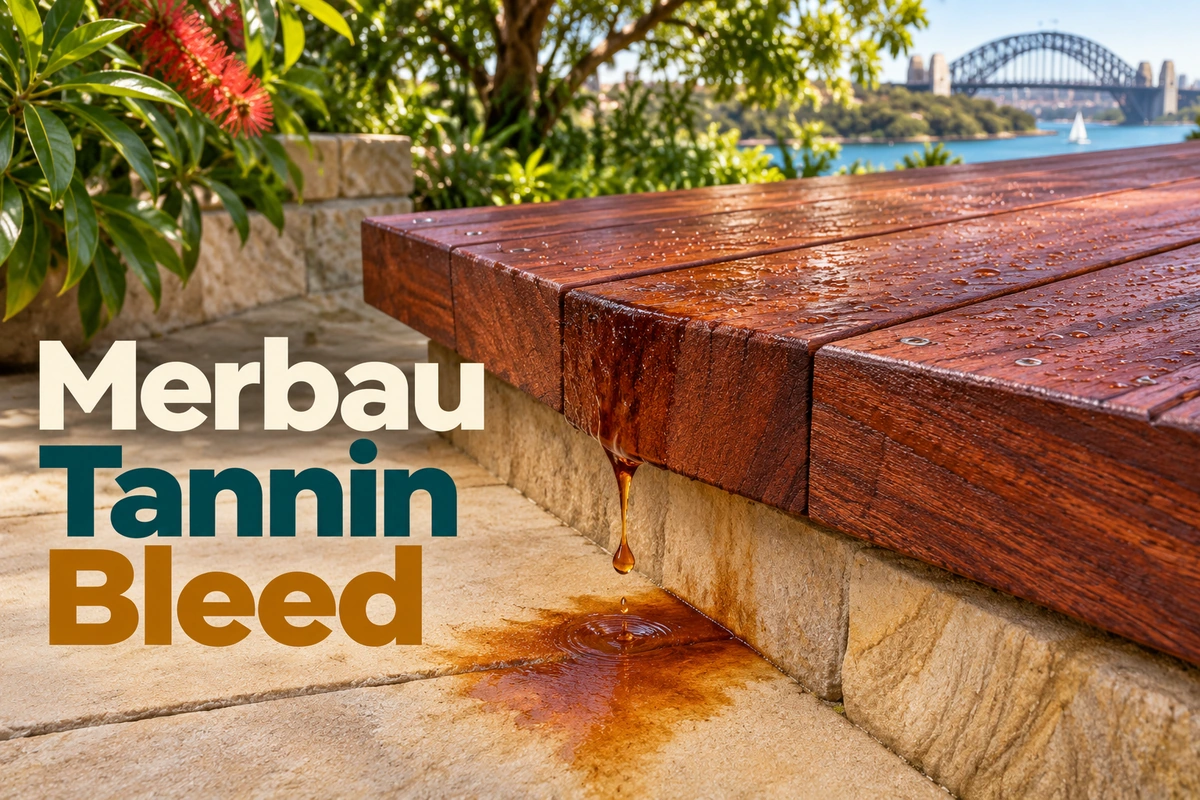
Merbau tannin bleeding is most noticeable when moisture carries reddish-brown extractives out of new timber. Check the runoff path, protect pale pavers and render, and identify whether the boards are bare, pre-oiled or already coated. Use the preparation method approved for that timber and finish, then let the boards dry before applying oil. For mixed old and new boards or persistent stains, our deck sanding and oiling Sydney service can assess the surface.
| What you see or know | What to check | Best next step |
|---|---|---|
| Tea-coloured drips below newer Merbau | Runoff after rain or washing | Photograph the path and protect receiving surfaces before any further washing |
| Blue-black spots near fasteners or metalwork | Possible iron reacting with timber extractives | Find and remove the contamination source where practical, then follow a compatible treatment |
| New bare boards with surface residue | Supplier and finish-maker preparation | Choose approved weathering or a matched prep system and trial a section |
| Factory pre-oiled or pre-bled boards | Exact factory treatment and compatible topcoat | Use both suppliers’ instructions before applying a remover or finish |
| Mixed replacement boards and old coating | Differences in absorption or adhesion | Test the groups separately and decide whether they can share a preparation system |
| Stained pale masonry, render or stone | Material and its approved cleaning method | Handle it as a separate surface and contain contaminated wash water |
How to Identify Merbau Tannin Bleeding
Moisture can carry coloured compounds from the timber onto adjacent surfaces. The pattern and timing of the marks provide a better initial diagnosis than colour alone.
Trace the stain back to water
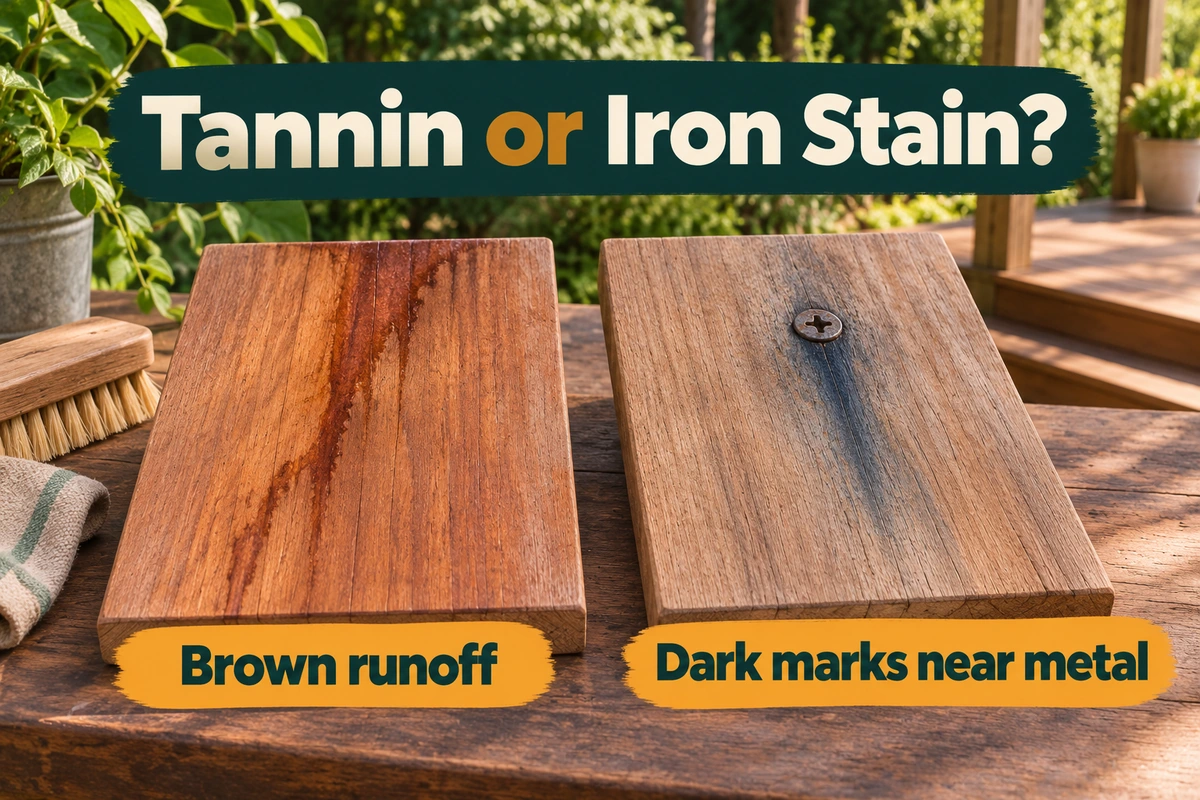
Tea-coloured trails after the first rains, darker sections at board ends, and brown drips onto a pale paver are consistent with tannin runoff. Start where the stain ends and look uphill or above it. Water can exit between boards, spill over a step or follow a post before it reaches a different surface. Marks that reappear along the same path after another wetting suggest the timber may still be releasing extractives.
The SpecRite Merbau installation guide explains that early wetting can leach tannins onto timber and adjacent surfaces. Natural colour varies across a Merbau deck, so review the boards when dry before treating grain variation as a stain. A matching red-brown trail on the paver beneath a board gap is a stronger clue than a single darker board on its own.
Look for a metal source around dark spots
Small blue-black marks near screw heads or under a metal object can indicate a reaction between iron and extractives in the wood. The SpecRite troubleshooting FAQ also identifies metal-contaminated runoff, construction debris and iron traces as possible sources. Think about recent grinding, soil tracked across the deck and water coming off nearby steel. The source matters because cleaning can leave a mark that returns at the next wetting if the contamination remains.
Dark marks can have other causes. Stagnant moisture under pots, spills, mould or an old finish can change timber colour and texture. Marks that sit on a failing coating need a compatible preparation decision before any oil is added. Photograph the area dry and record what sits above or touches it. Texture, location and recurrence give an applicator useful evidence.
Read more · Black Stains on Timber Floors: What Can Be Removed? covers identification on indoor timber. Use an exterior system for decking.
Protect Pavers, Render and Drains Before You Begin
Plan where water will go across and underneath the deck. Find the outlet from the area you intend to clean before any rinse or preparation product is applied.
- Check the deck edge, the underside of an elevated deck, steps, wall junctions and any slope towards a drain or pool. A path visible from the top can split under the boards.
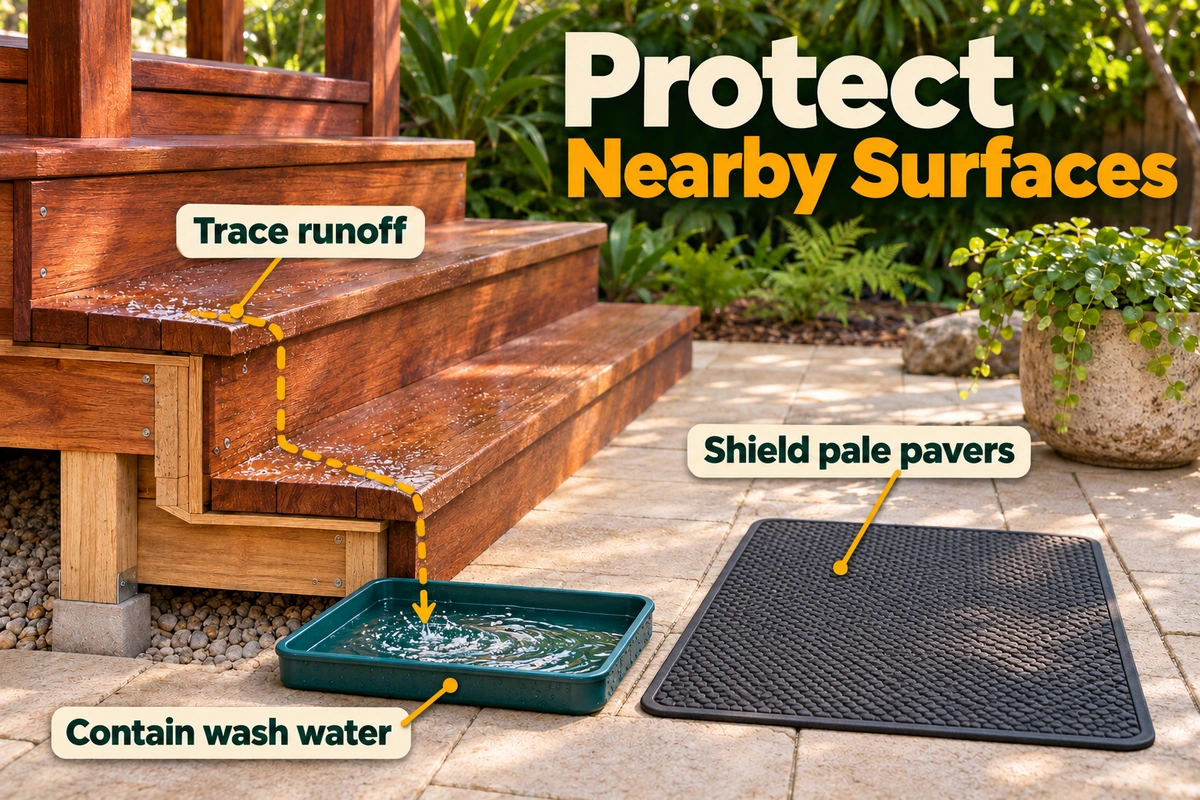
- Move pots, furniture and portable metal items away. Cover adjacent materials as the product instructs, and prevent temporary protection from diverting contaminated water onto another surface or causing a trip hazard.
- Protect porous or pale pavers, new render and stone before cleaning. Ask the installer or surface manufacturer about compatible protection and a safe cleaning method if runoff has already stained the material. A cleaner sold for timber is formulated for that substrate.
- Check the cleaner’s label and safety data sheet for personal protection, containment and disposal. The NSW EPA stormwater guidance explains why only clean rainwater belongs in stormwater drains. If effective containment is difficult, arrange professional advice before starting.
- Photograph existing marks before testing a procedure. Keep deck cleaning and masonry cleaning as separate tasks so success on one material can be assessed without mistaking a change on the other for improvement.
Read more · White Marks on Timber Floors: Causes and Next Steps is a related indoor guide if moisture has also reached interior boards.
Choose Preparation for Bare, Pre Oiled or Coated Merbau
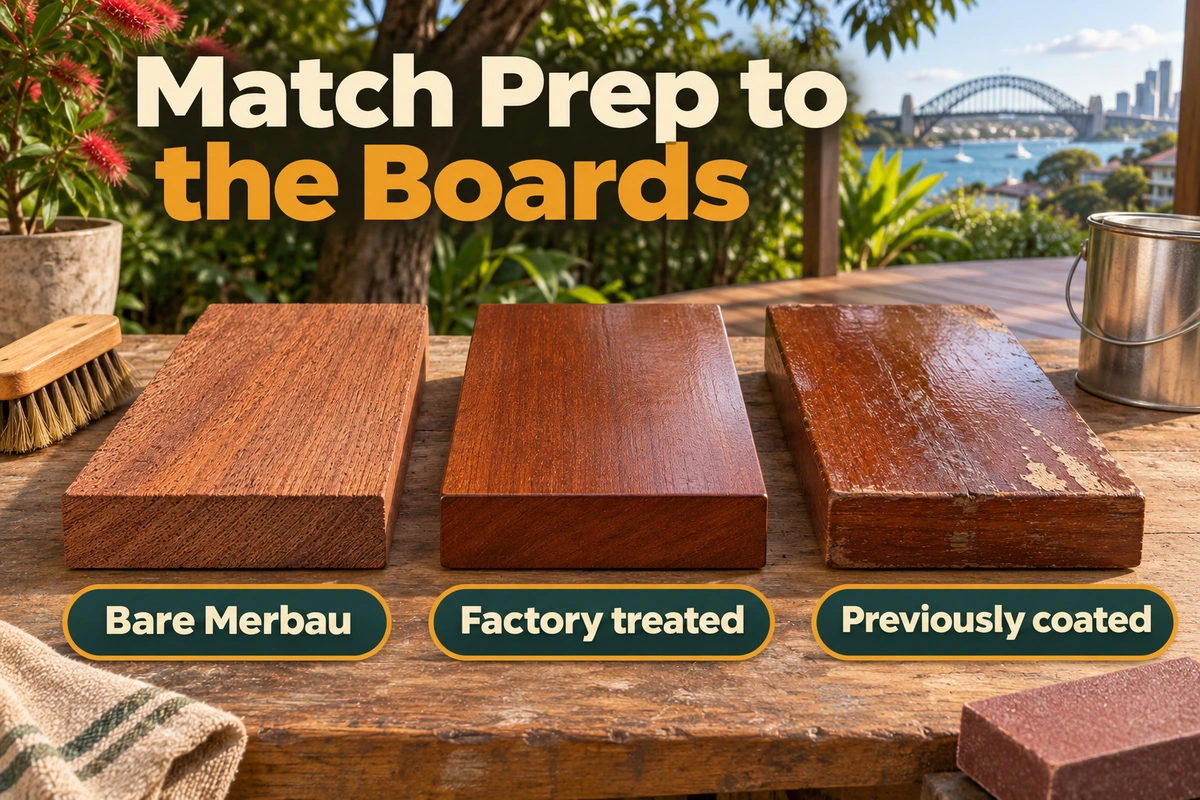
The invoice or supplier can tell you what was applied at the factory. Read that information alongside the new finish’s label, because a prep product suitable for bare timber can affect an existing coating.
New bare timber
Some systems use natural exposure to wetting and drying before finishing. The Intergrain preparation guide for new decks explains why timber species and actual weather matter for that approach. A sheltered landing gets less exposure than an open step, so elapsed weeks can be a poor guide to how evenly the surface has prepared. A compatible tannin and oil remover followed by the specified cleaner is another route when the coating maker approves it.
For a covered deck that seldom gets wet, ask the finish maker how to assess the sheltered boards before choosing natural weathering. A broad area that drains towards pale masonry may also be a poor candidate for repeated uncontrolled rinses.
If the system calls for a chemical preparation, follow the label sequence rather than mixing brands or substituting products with similar names. Use the required equipment, contact time, rinsing method and follow-up cleaner. Intergrain’s preparation instructions specify a stiff non-wire brush for its system. Rinse as directed, with runoff contained, and allow the timber to dry before coating.
Factory pre-oiled or pre-bled Merbau
Pre-bleeding can reduce the extractives available at the surface. The SpecRite care instructions for pre-bled timber still identify some potential for leaching, so surrounding finishes may still need protection. Pre-oiling describes a coating treatment. Ask for the product used and check whether the intended topcoat permits direct application over it or requires additional preparation.
Some finish systems publish specific exemptions for recognised factory oils. Intergrain’s UltraDeck data sheet, for example, names factory treatments that it accepts without the standard natural weathering process. An unlabeled board needs identification or compatible preparation advice before the same decision can be made.
Previously coated boards and mixed repairs
An old layer can make one board absorb unevenly while a new replacement board bleeds onto a step. Identify which boards are new, where the old finish is sound and whether any flaking layer is present. An all-over prep wash chosen for bare timber may change the old surface and leave the replacement boards looking different. If the planned finish requires bare timber, or an old layer is lifting, ask about compatible stripping or deck sanding Sydney and judge a representative trial before preparing the entire area.
Read more · Professional Deck Sanding Sydney Services for Long-Lasting Timber Restoration
Check the Deck Before Applying Oil
A dry-looking surface can still have damp seams or a mixture of bare and sealed areas. Check representative boards, then let the finish maker’s requirements determine whether application can proceed.
- Assess the dry colour in daylight. Note whether residue remains concentrated around metal, a drip line or a seam. If staining reappears quickly after the intended preparation, ask the coating supplier whether further treatment is appropriate.
- Check the shaded, sheltered and exposed areas as well as replacement boards. Follow any timber moisture limit in the coating instructions and use the appropriate method for checking it.
- Use a water-drop or absorption test only when it is part of the preparation guidance. If it is used, compare representative boards and let the area dry again. CUTEK’s preparation advice uses a water drop as a clue to an existing barrier on timber for its own system.
- Try the intended oil and tint on a suitable prepared spot if the system permits. Judge the dried result against adjacent boards. Old and new Merbau often look different on application, so use the trial to decide how much contrast is acceptable.
- Confirm the weather allows preparation moisture to clear and the chosen coating to develop. Keep irrigation and uncontrolled runoff away during the product’s restricted window.
Read more · Deck Oiling for Weathered Decks Sydney – Restore & Protect
A Worked Example: New Merbau Above Pale Pavers
Imagine bare Merbau steps fitted above pale concrete pavers. After rain, a tea-coloured trail runs from two cut ends across the pavers. A blue-black spot also appears beside a fixing where metalwork was recently done. The owner maps the two paths and checks the invoice for the board treatment. The timber supplier confirms the steps are bare. The owner photographs the separate marks and checks what protection the paver manufacturer permits.
The proposed deck oil accepts a matched preparation system for bare timber. The owner arranges a way to capture the wash water, moves nearby items and follows the system on a discreet section that includes a stair tread. For the black spot, the owner checks for metal debris and asks the supplier which treatment is compatible. The paver stain is assessed under its own care instructions, because a timber preparation chemical could affect the paver’s appearance.
Once the trial tread and its seams have dried, the owner checks for remaining residue and tests the intended oil where the label allows. If the prepared timber looks even enough and meets the label’s moisture and weather conditions, the owner proceeds using the same preparation across the bare treads. If runoff still cannot be controlled, if dark marks return or if the trial coat remains uneven, the owner pauses the wider job and gives the applicator the photos, the tin details and the list of steps already taken.
Read more · Deck Restoration: The Complete Guide for Sydney Homes
Frequently Asked Questions
How long bleeding lasts and how much staining remains depend on the boards and their exposure. The most useful checks follow the type of stain, the board treatment and the intended coating.
How long does Merbau bleed tannins?
The first wettings often produce noticeable runoff, and the timing varies with weather, exposure and treatment. Check the timber supplier’s care information and the finish maker’s preparation requirements rather than applying a fixed calendar rule to every board.
Does pre-bled Merbau still stain pavers?
It can. Pre-bleeding reduces some surface extractives, and residual tannins can still move with moisture. Protect vulnerable materials when preparing the deck or when early runoff is likely.
Can decking oil stop tannin bleeding completely?
A compatible finish can reduce exposure and help protect the prepared wood. Residual extractives may still leach, especially at gaps or exposed ends. Preparation and control of runoff remain useful when adjacent materials are sensitive.
Should I use the same cleaner on pale stone and the deck?
Use products and procedures approved for each material. Some masonry is acid-sensitive or has a sealer that can change appearance with the wrong cleaner. Ask the stone or paver supplier before testing an inconspicuous area.
Do I need to sand Merbau before the first oil coat?
Check the coating’s preparation route and whether the boards have a factory layer. Clean compatible bare timber may be ready after the specified preparation and drying. A failing old coating or incompatible factory layer can require a different process.
Book a Sydney Merbau Deck Assessment
Share the board supplier or coating name, photos of the dry timber and a photo showing where the runoff lands via Contact Us.
Mention whether the deck includes new and old boards or drains over a pool surround, render or pale masonry.
The deck sanding and oiling Sydney team can assess the condition of the timber and identify a preparation route for the selected finish.