
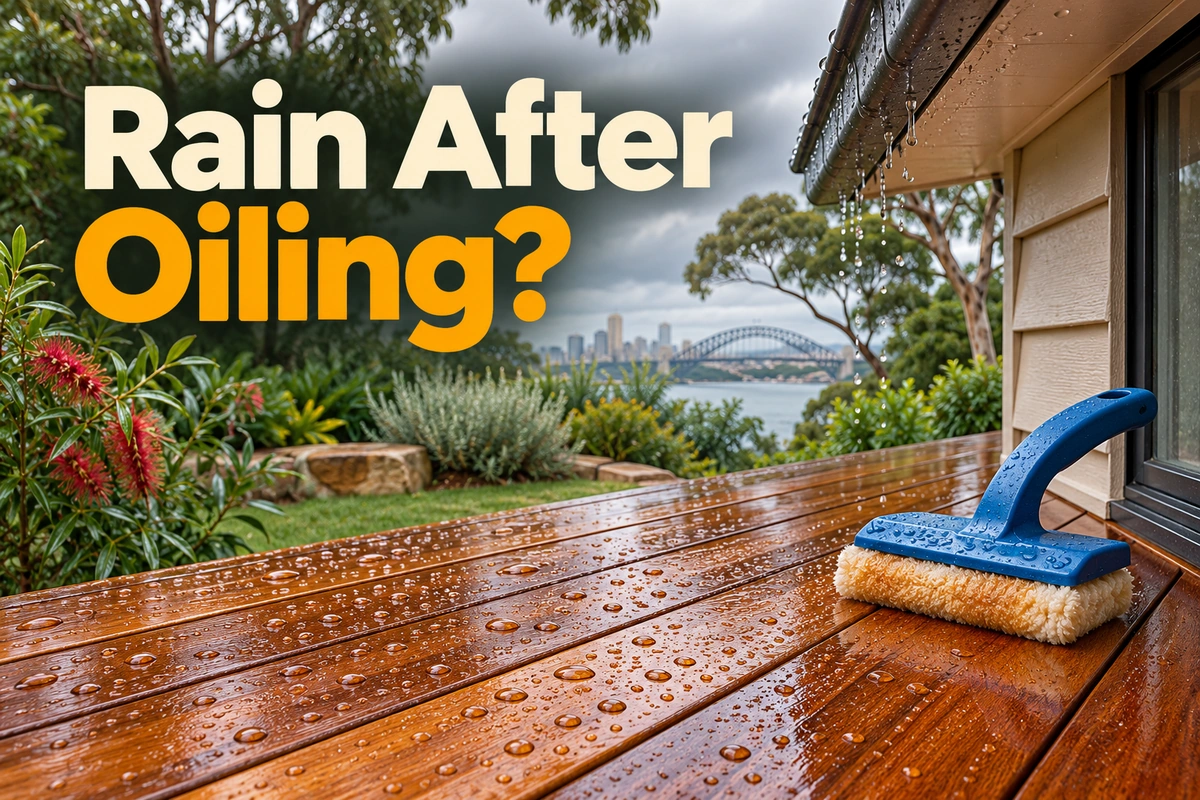
Rain after oiling deck boards can leave water rings, washed-out patches or a soft finish, particularly before the product’s stated rain-ready point. Keep people off wet boards, note when the rain began, and assess the whole surface once it is dry. A firm, even finish may need no repair. Persistent tack, bare patches or lifting need a product-specific response. For a hands-on assessment, see our deck sanding and oiling Sydney service.
| What you find | What it suggests | Best next step |
|---|---|---|
| Wet boards look darker but even out when fully dry | Temporary wetting | Let the coating continue to dry and follow the product’s access instructions |
| Dry boards have slight rings but feel firm | Possible superficial marks or local unevenness | Photograph and compare with a sheltered area before treating |
| Pale strips follow runoff or leave bare-looking timber | Possible displacement or loss of pigment | Ask the manufacturer about a test repair with the same system |
| Finish remains greasy, transfers or takes an imprint | Soft or excessive coating, delayed drying or contamination | Keep it closed to traffic and establish the cause before recoating |
| Edges lift or flakes appear on a film-forming finish | Local or widespread adhesion failure | Identify the system and assess preparation back to a sound surface |
| Red-brown water tracks lead off new hardwood | Possible tannin runoff | Check the timber and receiving surface separately |

What to Do About Rain After Oiling Deck Boards
A shower changes what the deck looks like before you can reliably judge what it has done to the finish. The most useful first steps collect evidence and give the surface a chance to dry without adding a second problem.
- Keep people and pets off the coated route while it is wet, slippery or still within the product’s restricted access period. If the deck is an essential exit, preserve safe egress and arrange access before you shut any route.
- Record the exact product, colour and coat number. Note the time the last section was coated and when water reached it. A photo of the tin and batch label is more helpful than a recollection that it was a “natural oil”.
- Photograph the area from a dry, safe position. Include the whole deck and the drip line, steps, low boards or exposed end grain where water collected. A second photo after drying makes wet darkening easier to separate from persistent change.
- Let the boards dry with airflow. Avoid putting a tarp directly on the finish, rubbing wet marks or adding oil while the boards are damp. If the product instructions describe immediate action for that exact finish, follow those instructions.
- Check the product’s response to early rain before cleaning. Some instructions call for a wash and dry before continuing, while others call for leaving the surface alone long enough to see whether the coating has been compromised. Have the label or technical sheet on hand for that decision.
Read more · Deck Restoration: The Complete Guide for Sydney Homes
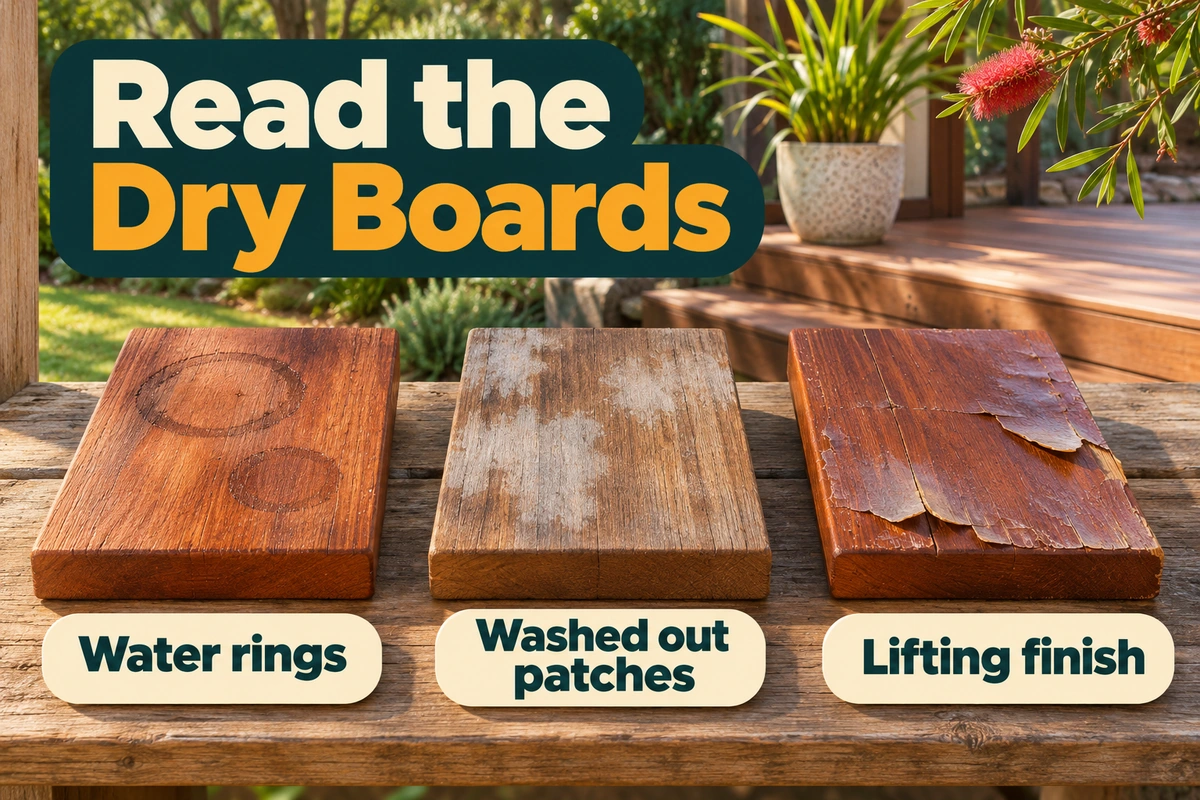
Read the Marks Once the Boards Are Dry
Compare a visibly exposed board with a sheltered board of similar colour and age. Grain and board colour vary, so the most useful comparison is a continuous board that passes beneath a roofline.
Rings, milky patches and brief changes in sheen
Water can sit as rounded droplets or collect along the edges of boards. Once dry, a ring of similar firmness to the surrounding coating can be a surface mark. Side lighting helps reveal whether it is a change in sheen or whether the surface has actually wrinkled, lifted or softened. A pale look across the whole deck while wet can also be misleading. Repeat the photos after the two areas have dried under their own conditions.
Some water-based finishes initially look milky during application. Cabot’s Aquadeck application guidance describes that appearance for Aquadeck before it dries. Persistent whitening following a shower needs assessment based on the exact coating and its state, especially if it coincides with a puddle line or the area remains soft.
Washed-out bands, dark streaks and exposed grain
A pale band below a gutter drip suggests water has concentrated there. A run down the slope or over a step nosing can redistribute pigment across an area larger than the original splash. Record where the marks begin and end. A straight line that follows the applicator’s path or a join may be a lap or application mark, so compare it with where rain actually travelled.
Brown streaks following the natural grain or draining from a cut end can also come from the timber. The SpecRite merbau installation guide describes tannin leaching and the resulting stains on nearby surfaces. When the runoff reaches a painted wall or a paver, inspect that material as a separate problem. A treatment endorsed for the deck can be unsuitable for masonry or render.
Tack, transfer and lifting
Once the product’s minimum time allows a surface check, use the manufacturer’s recommended way to check firmness. An area that remains greasy, takes an imprint or lifts beneath normal handling needs more attention than a colour difference alone. Avoid scraping and peeling at a film edge to test a large area. Photograph the boundary and let the manufacturer or an applicator advise how to assess adhesion without enlarging the problem. With a penetrating product, the issue may be excess oil or delayed penetration rather than a separable film.
Read more · White Marks on Timber Floors: Causes and Next Steps covers a similar visual assessment for indoor timber. Outdoor coatings have their own product instructions.
Choose Between Waiting, Spot Repair and Refinishing
Work from the smallest correction the product supports. The condition and compatibility of the remaining coating decide whether a trial area can be extended.
Wait when the finish is firm and the colour settles
If marks disappear on drying and the surface looks and feels consistent with the sheltered portion, further treatment may be unnecessary. Keep the final coat’s normal access restrictions in place and check again in good daylight. A note of the weather and a couple of photos can help if the colour changes later. Waiting also gives a still-soft finish time to develop under suitable conditions. Contact the manufacturer if it remains soft beyond the guidance for those conditions.
Trial a local repair after checking compatibility
If a dry, firm area has a visible small defect, find the instructions for the exact oil, tint and coat. A compatible local repair may work when the surrounding coating remains sound. A pigmented touch-up can deepen the area where old and new oil overlap. Select a discreet trial spot, apply the prescribed preparation and amount, and judge it in daylight after it has dried for the stated time. When possible, stop at a board edge or a natural break rather than leaving a hard line across the grain.
Product-specific advice can differ. The Bona Decking Oil technical sheet describes a possible thin reapplication if rain reaches the coating before it hardens. In the Deck-Max WOCA maintenance guide, the sequence starts with drying and assessment, then moves to preparation and reapplication if needed. Follow the system actually on the boards.
Step up to a larger repair when the coating has failed
Continuous flaking, soft areas over several boards or inconsistent adhesion across old and new coats can require preparation over a larger section. An installer can establish whether there is a sound boundary to work to and whether stripping, cleaning or deck sanding Sydney suits the existing finish. Sanding a greasy or incompletely set product can clog abrasives and smear residue. The surface needs to be assessed before deciding when and how to sand it.
| Condition after drying | Repair boundary to consider | What determines the decision |
|---|---|---|
| Scattered cosmetic spots on a firm finish | A discreet test section | Does the compatible treatment dry evenly? |
| One band of coating loss with sound boards nearby | Whole affected boards or a natural break | Does the edge blend and does the rest adhere? |
| Softness or lifting through several zones | A wider section or the full coated surface | Can the finish be prepared back to a consistent substrate? |
Read more · Professional Deck Sanding Sydney Services for Long-Lasting Timber Restoration
A Worked Example: One Shower, Two Different Zones
Imagine a deck with a roof over the back door and an exposed area beyond it. A shower hits after the first coat. Water runs off the roof onto two boards and pools near a step. The next morning the shaded deck still has damp seams. The owner notes the last application time and takes a wide photo from indoors. Looking across the wet boards makes the entire deck seem blotchy, so the owner postpones both the second coat and any test until the seams and exposed boards dry properly.
In dry daylight, the protected boards are even and the step has lost its dark patches. A distinct pale strip remains under one roof drip. The surrounding finish appears firm. The owner gives the product manufacturer the name, batch, coat number and weather history. The manufacturer recommends a compatible test on a small affected section. The owner marks the trial boundary at a board edge and compares it with the neighbouring board once the instructed drying interval has passed.
If the repair blends and the surface stays firm, the owner can extend it to the affected section in a proper weather window. If the trial still lifts or leaves an obvious darker band, the visible boundary may have to move to an entire board or natural break. If both sections remain tacky, the repair decision changes again. That broader sign points towards product, preparation or conditions, so a deck assessment is more useful than repeating the spot repair across the surface.
Read more · Black Stains on Timber Floors: What Can Be Removed? discusses indoor timber and why a dark mark’s cause matters before refinishing.

Plan a Better Weather Window for the Next Coat
Start the post-coat weather clock when the last exposed board is finished. A suitable forecast also has to leave enough time for timber to dry after any washing and for every coat to meet its own conditions.
- Check the exact product’s rain and dew precautions. Intergrain’s UltraDeck technical sheet distinguishes conditions for light rain after the final coat. A different product can require a much longer dry period.
- Look for roof drip lines, garden irrigation and shaded steps that stay cool into the afternoon. These places can receive water even on a day the local forecast shows little rain.
- Work back from the earliest likely shower or dew. Leave time for the final section and allow for cooler conditions if the label provides a separate timetable.
- Follow the preparation and application instructions for that exact system. If it uses oil-contaminated rags, follow the safety sheet and local disposal advice. The Metropolitan Fire Service guidance on self-heating explains why oil-bearing waste can ignite when bunched up.
- Arrange a route out after the last board is coated. If the deck is the only usable entrance, coordinate the job and access plan before starting.
Read more · Deck Oiling for Weathered Decks Sydney – Restore & Protect
Frequently Asked Questions
The exact-oil instructions determine whether a rain event changes the next step. Timing, the extent of the marks and the condition of the dry surface help narrow the options.
Should I wipe rainwater off a freshly oiled deck?
Avoid rubbing a wet coating or walking across it to reach the water. Keep clear until the area can be accessed safely. Use any product-specific recovery instructions when deciding how to handle pooled water.
What if it rains between coats?
Write down which areas received the first coat and how long they had before rain. Let the deck dry and check for tack or coating loss. Follow the manufacturer’s cleaning and preparation sequence before adding a coat. Starting the second coat while the first is compromised can make a repair harder to isolate.
Does a light shower always leave a mark?
Some products allow light rain after a specified period in suitable conditions. An earlier shower, roof drip or persistent puddle can affect individual boards differently. A check after drying gives a better indication than the rainfall description alone.
Can I sand off the water marks right away?
Establish whether the coating is dry, firm and suitable for sanding first. A soft coating can smear and gum up abrasives. For slight marks on sound boards, a product-approved local treatment may resolve the appearance with less disruption.
When does the deck need a professional assessment?
Seek an assessment if coating is lifting across multiple boards, the surface stays soft, or an unknown film prevents a compatible repair. Also arrange an inspection if the deck has loose, soft or unstable boards. A finish repair cannot address an underlying board or support problem.
Book a Sydney Deck Coating Assessment
Send photos and the product name through Contact Us so the team can see where the rain reached the deck and which areas still look different after drying.
Include the coat number, the time between application and rain, and an example from a sheltered board.
If the issue extends beyond surface spotting, a deck sanding and oiling Sydney assessment can establish how much timber needs preparation before a compatible finish is reapplied.